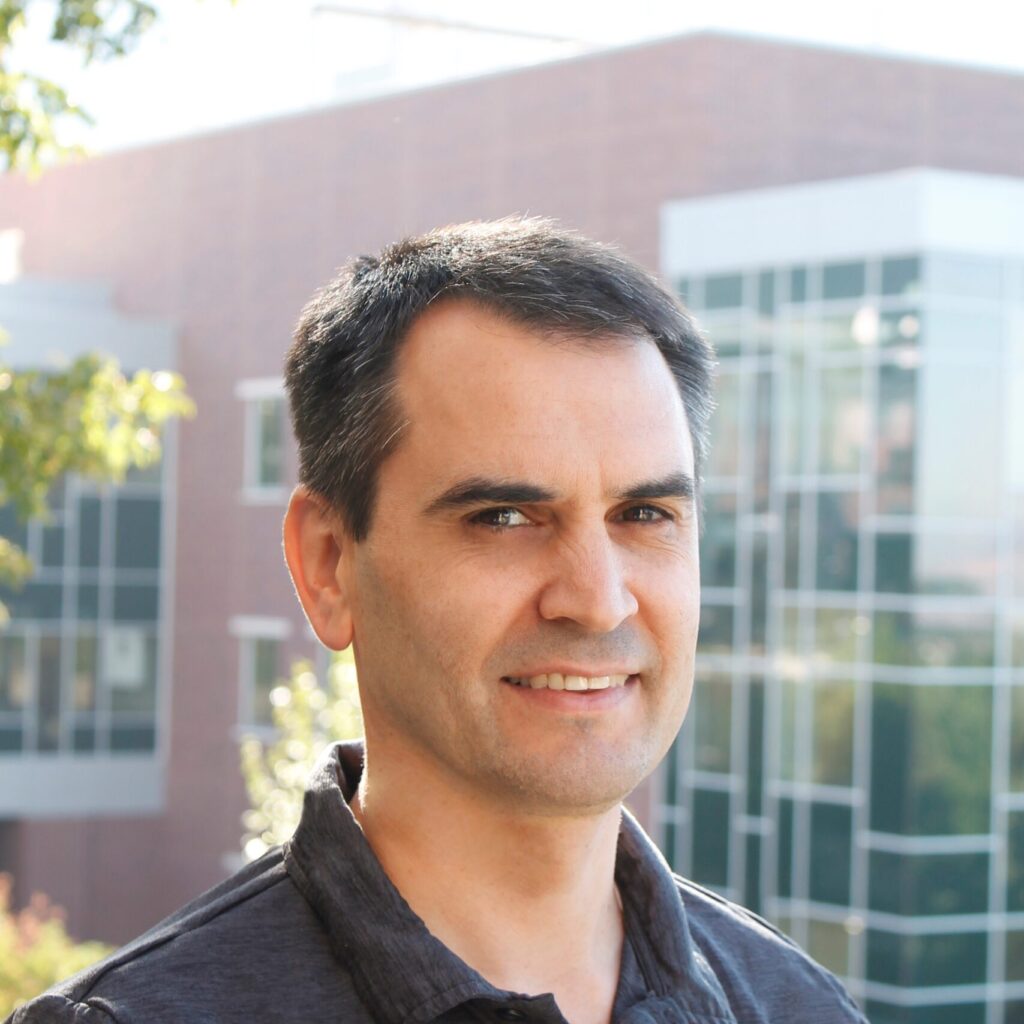
Prof. Ryan Kelly will be joining our MSBM Invited faculty in 2026. Ryan is Associate Professor in the Department of Chemistry and Biochemistry at Brigham Young University in Utah.
To get to know Ryan ahead of MSBM 2026, I spoke to him about his mass spectrometry education, how he’s using mass spectrometry in his research, and what he’s looking forward to about MSBM:
Ryan it’s great to have you joining us at MSBM for the first time, it’ll be great for our students to learn about ESI, Nanospray and Ambient Ionization. Ahead of our 2026 event, let’s learn a little about your own mass spectrometry education, research, and what you’re looking forward to at MSBM:
Q. What first drew you to work in mass spectrometry?
Ryan: My graduate studies were focused on microfluidics and I never touched a mass spectrometer. Along the way, I became aware of how powerful the mass spectrometry was with its ability to identify and quantify thousands of biomolecules in a single analysis. I joined a mass spec group for my postdoc and never looked back.
Q. When you think about your education in Mass Spectrometry, are there particular people or events which really help you learn?
Ryan: : I was originally drawn to the great researchers who figured out electrospray ionization mass spectrometry (ESI-MS) and the coupling of LC with ESI. John Fenn, Matthias Mann with nanoESI and Richard Smith were key influences. LC-ESI-MS seems so straightforward, but generating those ions and getting them to the high vacuum region of the mass spectrometer with reasonably high efficiency to many years and a lot of brainpower to figure out.
Q. Do you have a favourite instrument you’ve worked with? Perhaps the newest shiniest piece of equipment in your group or an old workhorse mass spectrometer from your first time working in the field?
Ryan: The latest generation instruments such as the timsTOF Ultra 2 and the Orbitrap Astral (along with newer versions) have me spellbound. It is just incredible how fast and sensitive they are. We can now quantify tens of thousands of peptides from single cells in about 5 minutes of analysis time. Seems like science fiction but it’s happening!
Q. I read your article talking about “The $10 Proteome” earlier this year. If you think ahead 5-10 years, what impact could low-cost proteomics have on biology & medicine?
Ryan: : I think there are many, many samples that we’d like to profile, but the measurement costs have just been too high. With the cost around $10 or even $50, we might be able to obtain a full plasm proteome profile for every person who comes in for a routine physical exam. This will not only accelerate biomarker discovery, but will move healthcare from reactive to proactive and personalized. We will be finding addressable warning signs from patient samples long before any symptoms appear.
Q. Sticking with that theme, if you were writing a paper in a few years called the “The $1 Proteome” – what breakthroughs or advances would you expect to need to see to achieve this?
Ryan: The cost of the mass spectrometer is a major driver of the cost of the whole analysis. If we can go even faster with the measurements, the costs will come down.
Q. One of the goals of MSBM is helping students build networks that last well beyond the summer school. Looking back at your own career, are there any long-term collaborations that have been especially important, and how did they begin?
Ryan: For my postdoc, I joined a research group of about 100 people with half of those being fellow postdocs. I still see many of them as I go to conferences, and we are able to support each other even 20+ years later. I would imagine this MSBM summer school is going to build similar lasting friendships and networks.
Q. What skills beyond technical ability make someone successful in mass spectrometry?
Ryan: Science is surprisingly social, so being friendly and taking an interest in fellow scientists as people goes a long way. In addition, science has no impact if it isn’t communicated, so speaking and writing skills are essential.
Q. Have you visited Croatia before? If not, what are you most looking forward to?
Ryan: I have not, and I am so excited to get there! The pictures are absolutely gorgeous, and I hear the gelato is also fantastic!
Q. Outside the lab, what’s something you enjoy that might surprise people?
Ryan: Well, I love to cycle. I am also a family man, and am excited that one of my 4 adult children will be starting a PhD program in mass spectrometry starting this year.
Q. We have the faculty vs student volleyball match again this year — should students be worried about your volleyball abilities?
Ryan: Absolutely nothing to fear. Watch out if there is a ping pong table though. Or Scrabble.
Ryan’s experience of working with such a large group which fostered connections and collaborations which have followed him through his career is great to hear about, and something which our students benefit from when joining the MSBM Alumni. He’ll also be teaching our students about the very topics which he cites as inspiration for working in mass spectrometry – Electrospray Ionization and Ambient Ionization.
Sadly, there is no MSBM Scrabble tournament (yet!) for Ryan to flex his skills!
MSBM will run from the 5th to the 10th July 2026 this year, hosted in the UNESCO World Heritage City of Dubrovnik, Croatia. It’s an excellent opportunity to experience a crash course in Mass Spectrometry Fundamentals & Applications, meet with industrial experts and vendors, and build your network with peers and faculty.
We previously spoke to Prof. Lekha Sleno to get to know her ahead of MSBM, and you can read a little about the rest of our 2026 Faculty and Organising Committee here.
Got any questions? Check out our Frequently Asked Questions (FAQ) page or contact the team at [email protected]
0 Comments